Thermostat calls
Controls and low-voltage wiring send the request for heat.

The first cold morning should not be the furnace’s first full test. Our maintenance visit follows the heating sequence, checks the parts that protect it, and separates ordinary cleaning from conditions that need repair or a safety decision.
A furnace can sit quietly for months while dust settles, a filter loads up, a vent termination becomes obstructed or a control begins to fail intermittently. Renovation and summer cooling work can also change airflow or wiring around the same equipment.
Start the visit with what happened in the house, not just the age printed on the furnace label.
Checking random parts can miss the connection between them. We watch how the furnace receives a call, proves safe conditions, makes heat, moves air and shuts down.
Controls and low-voltage wiring send the request for heat.
On a gas furnace, inducer, pressure switch, ignition and flame proving have to occur in order.
Burners or electric heat stages operate while limits and controls monitor conditions.
Motor, wheel, filter, coil and duct system shape temperature rise and distribution.
The heat call ends, burners or elements stop, and the blower completes its off-delay.
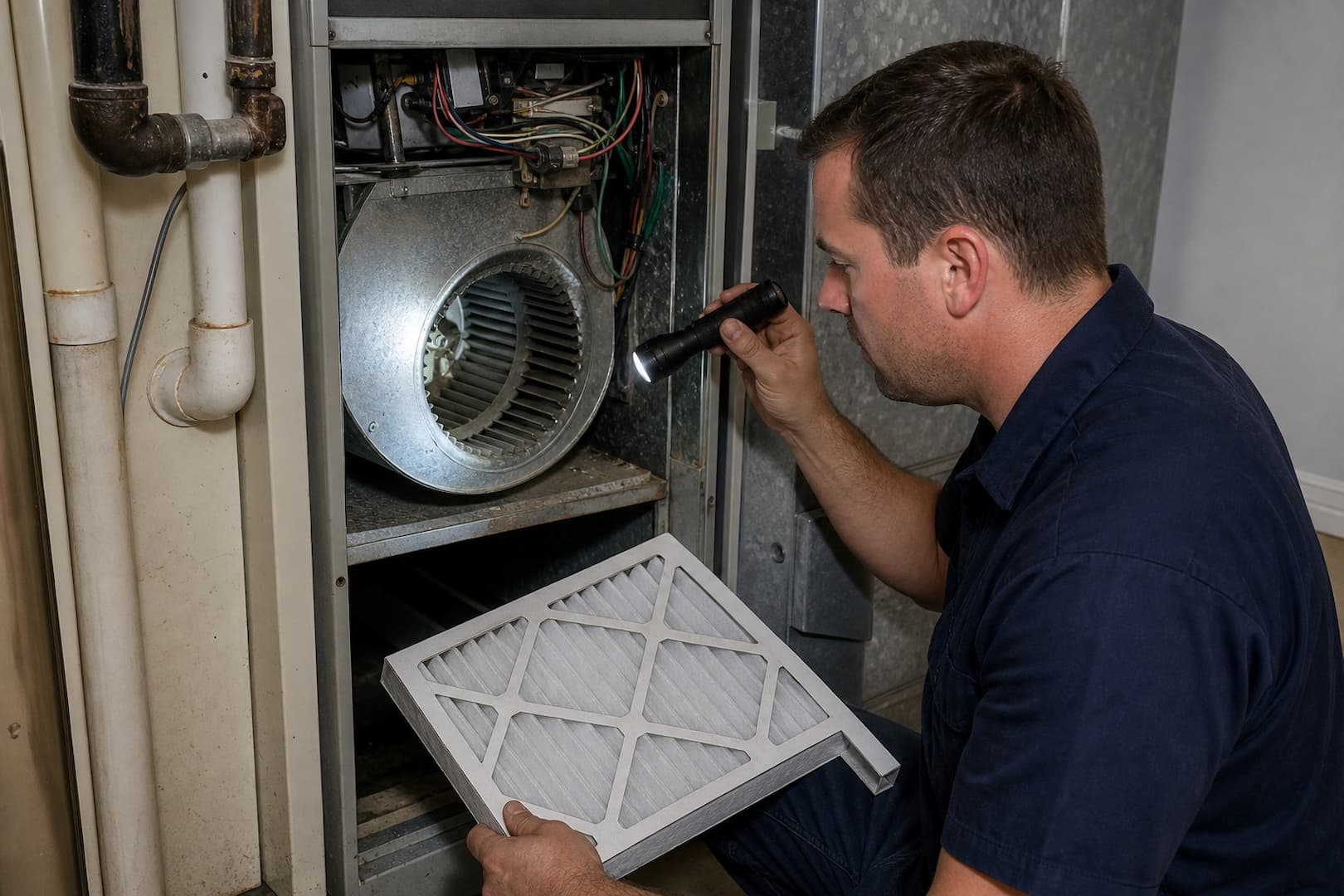
A furnace may create heat normally and still deliver it poorly. A loaded filter, dirty blower wheel, restricted indoor coil or weak motor can change airflow and temperature rise. High-limit trips may follow.
We look at the air side as part of furnace maintenance, especially when rooms heat unevenly or the system sounds different after the blower starts.
Combustion adds ignition, flame sensing, burners, gas components, draft, venting and safety controls. High-efficiency furnaces also create condensate that has to drain in cold weather.
There is no burner or flue, but high-current electric heat still depends on staged controls, limits, wiring and airflow. A weak connection or restricted air path can become a serious operating problem.
Shut the furnace down if you see smoke, smell a persistent burning-electrical odor, hear a severe mechanical sound or suspect combustion gases in the home. If a carbon monoxide alarm sounds, leave the building and follow the alarm manufacturer’s and local emergency guidance.
Frequent resets hide a fault; they do not cure it.
Do not keep resetting protection that trips again.
Turn the system off and arrange qualified evaluation.
Condensate belongs in the drain, not on controls or the floor.
A maintenance report should help you make a decision months later, not just prove that an appointment happened. We note the equipment condition we can access, what the furnace did during the heat call and which findings may deserve follow-up.
We can document accessible wear, contamination, operating behavior and measurements under the conditions present during the visit.
A normal finding, an item to watch, a repair recommendation or a safety-related evaluation should be clearly distinguished.
Maintenance lowers avoidable risk; it cannot promise that an aging component will not fail later or reveal every hidden defect.
Annual professional maintenance before or early in the heating season is a common schedule for residential furnaces. Equipment instructions, fuel type, runtime, household dust and prior findings can change the practical interval.
Cleaning may be part of the work, but it is not the whole visit. A useful tune-up also checks the operating sequence, thermostat call, safeties, blower and airflow, venting or condensate where applicable, electrical condition and the way the furnace starts and shuts down.
The exact work depends on the furnace. Typical areas include ignition and flame sensing, burner condition, inducer and pressure-switch sequence, venting, condensate on high-efficiency equipment, accessible gas and electrical connections, blower operation, temperature rise and safety controls.
Yes. They do not have burners or combustion venting, but they still depend on electric heat stages, sequencers or controls, high-limit protection, blower performance, wiring, filters and duct airflow.
A furnace that does not heat, locks out, trips a breaker, smells like burning material or shows another active failure needs a repair appointment. Maintenance is preventive; diagnosis follows the failed sequence and may require different time or parts.
A maintenance visit can identify visible damage, abnormal flame or combustion clues and conditions that justify further evaluation. No brief visual check can guarantee that every hidden defect will be found. If a safety concern appears, we explain the next diagnostic step and keep the furnace out of normal operation when required.
Tell us what kind of furnace you have, when it last received service and what you noticed during the previous heating season.
Complete the form and our team will contact you about the next available scheduling options.